What If the Model Never Described You?
Jul 13, 2026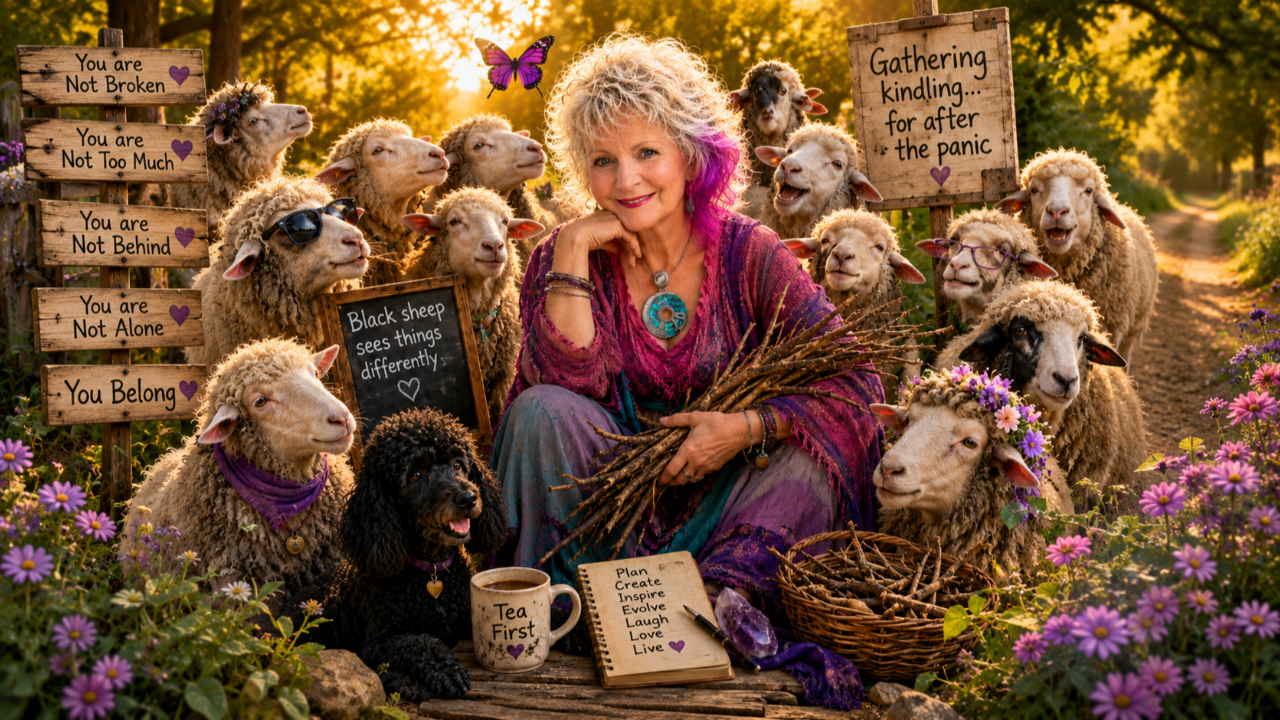
I recently came across a word that caused me to re-evaluate nearly seventy years of my life.
Otrovert.
It describes someone who can be social, warm and connected, but does not naturally derive their identity from belonging to a group.
My first response was recognition.
My second was irritation.
Because, of course, the author then began describing the characteristics of people who do not identify with groups and essentially said:
You will know if you are one of this group.
And my immediate thought was:
Stop trying to put me into a group.
Which may be fairly convincing evidence that the description fits. 😂
But beneath the humour, something much bigger happened.
For most of my life, I have been able to move into groups and out again.
I can enjoy people.
I can care about them.
I can belong to a pottery group, a craft group, a spiritual group or a professional group without ever really becoming part of the group.
I have often been the same with family.
And with relationships.
For years, I interpreted this through the only model I had available.
If other people seemed to experience belonging, intimacy and togetherness differently from me, perhaps I was simply not very good at them.
People could tell me I was not broken.
I could tell myself I was not broken.
But somewhere underneath that reassurance was always a question.
Based on what?
If I was not broken, why did I experience things so differently?
Why could holding hands while walking feel less like romance and more like being forced into someone else's rhythm?
Why could another person's need for agreement feel like pressure?
Why did "we" sometimes feel as though it came at the expense of "me"?
Then I was given a different reference point.
Nothing about me changed.
But the model changed.
And suddenly I could ask a completely different question.
What if I had not spent my life failing at the model?
What if the model simply did not describe me?
When Connection Comes With a Hidden Invoice
This new reference point has also made me reconsider intimacy.
I don't think I dislike intimacy.
I dislike the demand that can sometimes sit underneath it.
Prove you love me.
Agree with me.
Want what I want.
Do this with me.
Move at my pace.
Reassure me that we are a "we."
For another person, these things may be perfectly natural expressions of love.
For me, the moment connection becomes evidence I am required to provide, it changes.
It comes with a hidden invoice.
And yet I know I can receive deeply.
When care is clean.
When there is no pressure.
When I am not being asked to reassure the person giving it.
When receiving does not create a debt.
That has made me wonder whether some of us are not incapable of intimacy at all.
Perhaps we are simply highly sensitive to intimacy being used as proof.
Who Set the Pace?
There is a very ordinary example that has helped me understand this.
When two people walk together, one may naturally walk faster.
The other walks more slowly.
Without anyone consciously deciding it, the faster person's pace can become our pace.
The slower person is now lagging behind.
They are the one who is not keeping up.
But who decided?
How did your pace become our pace?
Why wasn't mine chosen?
Why wasn't there a pace somewhere between us?
And this is about much more than walking.
One person's preferred amount of touch can become the correct amount of touch.
One person's need for shared activities can become the measure of closeness.
One person's anxiety can become the pace of a household.
One person's version of love can become the test another person must pass.
And the person who moves differently becomes the problem.
Too distant.
Too independent.
Not affectionate enough.
Not trying hard enough.
Perhaps the question was never:
Why can't you keep up?
Perhaps it was:
Who decided this was the pace?
When One Person's Feelings Become the Weather
Every relationship affects us.
We are not completely separate beings who move through life untouched by one another.
But there is a difference between affecting the people around us and becoming the permanent weather system they must live inside.
In some relationships, one person's anxiety changes everyone's plans.
One person's mood changes the atmosphere.
One person's disappointment requires immediate attention.
The other person becomes the one who adjusts.
Understands.
Waits.
Accommodates.
Soothes.
And often, the person at the centre of the weather genuinely cares.
But I have come to believe there is a difference between caring internally and care that becomes action.
You can care deeply about someone and still fail to factor them into your decisions.
You can love someone and still expect their life to organise itself around yours.
You can feel terrible that someone is hurt while doing nothing differently.
Care that remains inside us may be genuine.
But it does not automatically become care for another person.
Perhaps Interdependence Is Not Fifty-Fifty
This has led me to another idea I am exploring.
Weighted interdependence.
Everything in life is interdependent.
Bodies.
Families.
Communities.
Forests.
Rivers.
Animals.
Microbes.
Humans.
Nothing exists entirely alone.
But healthy interdependence does not mean everything gives and receives exactly the same amount at every moment.
Sometimes one person needs more.
Sometimes another gives more.
That is life.
The question may not be whether the system is equal today.
Perhaps the better question is:
Can the weight move?
Can the person who usually needs less be allowed to need more?
Can the carer become the cared-for?
Can one person's feelings matter today without becoming the permanent climate everyone else must live inside?
Can the system notice when one part has been carrying too much?
Can it adjust?
Can it rebalance?
Perhaps true interdependence is not equal weight at every moment.
Perhaps it is the capacity for the weight to move.
A Different Way of Being OK
When I was young, the idea of "I'm OK, You're OK" was everywhere.
If I am truthful, my version was probably closer to:
You're OK.
And I'm OK at a pinch.
I could accept other people's differences.
I could try to understand them.
I could cut them slack.
But somewhere underneath it all, I still wondered whether my own difference meant there was something wrong with me.
Now I can say something different.
I am OK.
And you are OK.
On both sides of the fence.
That does not mean we are the same.
It does not mean we have the same temperament, needs, history or way of processing the world.
It does not mean I must abandon my boundaries.
It does not mean you must become like me.
It means neither of us has to be wrong simply because we are different.
And perhaps that is why the word navigator has always felt more comfortable to me than healer.
I do not need to fix people.
I do not need to decide they are broken.
I do not need them to become like me.
Perhaps my work is simply to stand beside someone for a while, look at the terrain with them, and help them find a way of living that is valid for the person they actually are.
Not the person the group says they should be.
Not the person their partner needs them to become.
Not the person spirituality says they would be if only they were sufficiently evolved.
The person they actually are.
Because sometimes reassurance is not enough.
Sometimes being told you are not broken does not help when every model you have been given still says you are doing life incorrectly.
Sometimes what changes everything is finding a reference point that finally allows you to ask:
What if I was never broken?
What if the model simply never described me?
With steadiness and wonder,
Shamarie
Mystic Navigator, Field Explorer & Interpreter of Living Patterns
You can explore this topic in more depth and join the conversation —
leave a comment on my blog at https://www.shamarie.com.au
Join me in exploring how energy, awareness, and daily life weave together to create a sanctuary of coherence and calm. 🌿
Connect with me on Facebook and Instagram @ShamarieFlavelEnergy,
visit shamarie.com.au to explore more, or discover my courses at evolvecourses.shamarie.com.au .
Stay connected with news and updates!
Join our mailing list to receive the latest news and updates from Evolve Courses
Don't worry, your information will not be shared.
We hate SPAM. We will never sell your information, for any reason.